
-Choosing the right stretcher feels complicated. You need equipment that is reliable for every patient, but using the wrong size stretcher for a child can introduce serious, hidden risks1.
The most important size differences are not just about length. They involve the stretcher's center of gravity2, the specific placement of restraint points3, the height of the side rails4, and the width of the undercarriage. Each feature is engineered differently for adult and pediatric patients.
I've been in the medical equipment manufacturing business for a long time, and I've learned that the small details can make a huge difference in an emergency. You might think a smaller stretcher is the only thing needed for a smaller patient, but the reality is much more complex. These differences in design are not just for comfort; they are critical for patient safety5 and the efficiency of your team. Let's break down exactly what you need to look for when deciding between pediatric and adult stretchers.
Why Isn't a Pediatric Stretcher Just a Smaller Adult Version?
You need a stretcher for children and are tempted to just find a smaller adult model. This approach overlooks key safety designs, putting your smallest patients at risk during transport.
A true pediatric stretcher6 is completely re-engineered. It has a different center of gravity2 for stability, specially placed restraint points3 for a child's body, and lower side rails4 for better paramedic access. It is not simply a scaled-down adult stretcher.
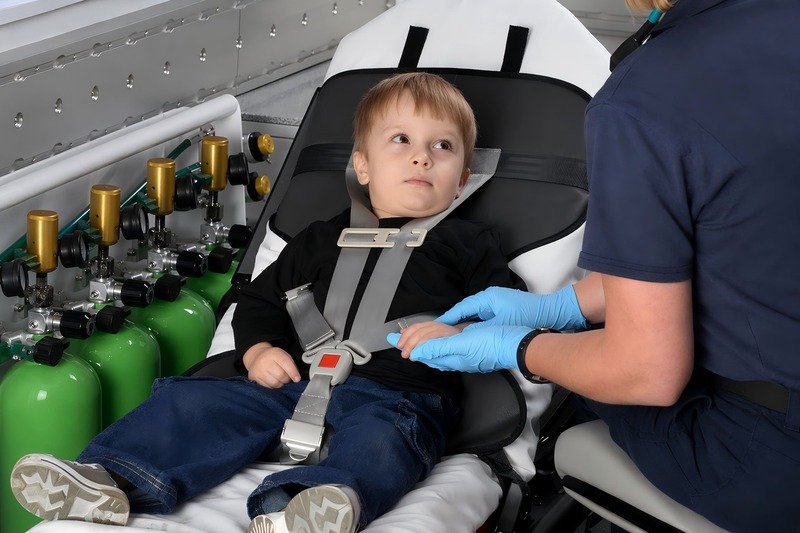
When we design and manufacture stretchers, we start from the patient. A child is not a miniature adult. Their body proportions are completely different, and this fact must guide the entire design of the equipment. I once saw a team struggle to stabilize a child on a small adult stretcher, and it highlighted these hidden dangers. The problem is that scaling down a design does not scale down the laws of physics. A child's head is proportionally larger and heavier than an adult's, which dramatically changes the stretcher's center of gravity2. A purpose-built pediatric stretcher6 accounts for this to prevent tipping and ensure stability. The restraint points3 and side rails4 are also critical.
Key Design Differences
| Feature | Standard Adult Stretcher | Purpose-Built Pediatric Stretcher | Why It Matters for a Child |
|---|---|---|---|
| Center of Gravity | Designed for adult body proportions. | Recalculated for a top-heavy child. | Prevents the stretcher from becoming unstable or tipping. |
| Restraint Points | Spaced far apart for an adult torso and legs. | Placed closer together and are more adjustable. | Secures a small body properly and prevents sliding during stops. |
| Side Rail Height | High to contain an adult. | Lower and often adjustable. | Allows paramedics easier access for monitoring and care. |
Does Stretcher Size Affect Ambulance Loading More Than You Think?
Your new stretcher seems to fit the patient, but your team struggles to load it into the ambulance. This mismatch wastes critical time and increases the risk of injury to everyone involved.
Yes, the stretcher's undercarriage width7 is often more important than its length for efficient loading. If the frame doesn't perfectly match your ambulance's locking system and interior pathway, it can cause jams, delays, and unsafe handling maneuvers.
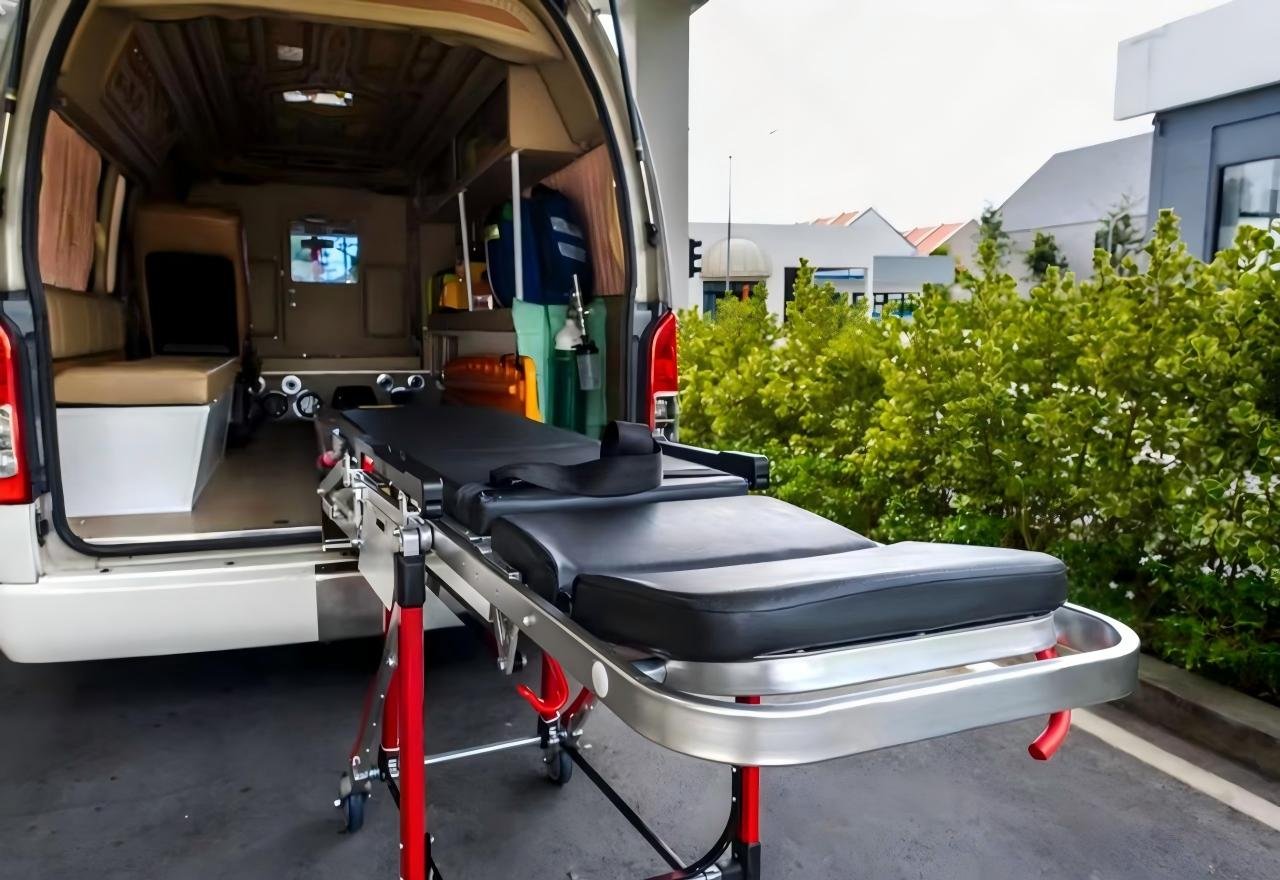
I always advise our clients to measure their ambulance bay before they even look at stretcher models. Many people focus on the overall length and width of the stretcher bed, but the real challenge happens underneath. The undercarriage, the wheeled frame of the stretcher, has to align perfectly with the locking mechanism inside the ambulance. If the width is off by even a small amount, the stretcher won't lock in securely. This can lead to a dangerous situation where the stretcher could move during transit. Furthermore, the width of the frame determines how easily your team can navigate the aisle inside the ambulance. A frame that is too wide can make it nearly impossible to move around the patient to provide care. This is a detail that, from my experience, is a frequent source of frustration for EMS teams. It’s a simple measurement that can prevent a major operational headache.
The Danger of "Fixation Gaps"
Even if a stretcher fits into the ambulance, using an adult-sized one for a child creates another serious risk: fixation gaps8. The straps are designed to secure a larger body. When you place a small child on it, even when the straps are pulled tight, there is often too much empty space around the child. During a sudden brake or a sharp turn, the child's body can be thrown around within the restraints. This movement can be violent enough to cause secondary injuries or dislodge IV lines and monitoring equipment. It’s a terrifying scenario that is entirely preventable with size-appropriate restraints.
Can You Safely Use an Adult Stretcher for a Child Patient?
You want to save money by having one stretcher that handles all patient sizes. But using a standard adult stretcher for a child without the right modifications is a major liability.
You can, but only if the adult stretcher is specifically designed and certified to work with pediatric accessories. These systems create a secure, size-appropriate space for the child, effectively turning the adult stretcher into a safe transport platform.
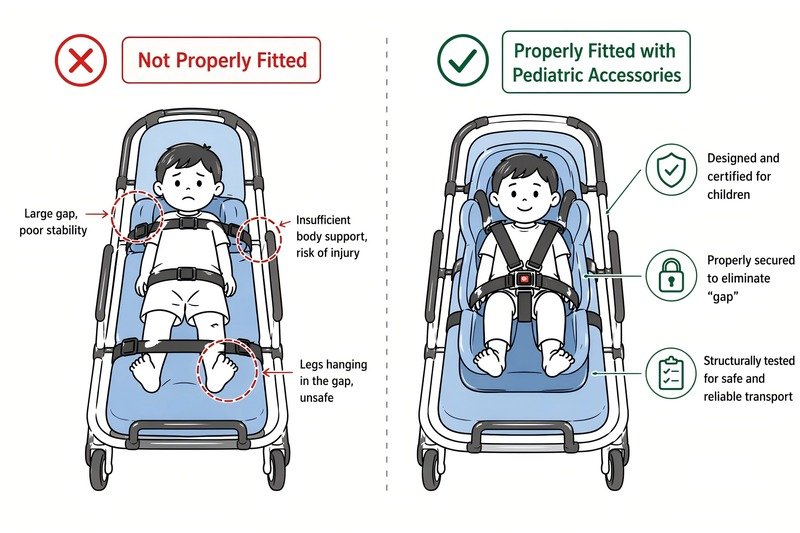
Many of our B2B clients, especially those outfitting large fleets of ambulances, ask me about this. They want versatility, and I understand that. The solution is not to use a standard adult stretcher and hope for the best. The solution is to purchase an adult stretcher that has been designed from the ground up with pediatric transport as a possible function. These stretchers have designated attachment points and are structurally tested to support specialized pediatric inserts or harness systems. These accessories are not just cushions; they are engineered medical devices. They wrap around the child and then anchor securely to the stretcher frame, eliminating the dangerous "fixation gaps8" I mentioned earlier. When you're sourcing equipment, you must ask the supplier for proof that the stretcher and the pediatric system are designed to work together.
What to Look For in a Versatile Stretcher
When considering an adult stretcher for occasional pediatric use, ask your supplier these questions:
- Compatibility: Do you offer a pediatric restraint system9 specifically designed and tested for this stretcher model?
- Certification: Can you provide documentation or certification for using this stretcher with the pediatric accessory?
- Functionality: Does the system create a cocoon or harness10 that secures the child, rather than just using the existing adult straps?
- Weight Range: What is the certified minimum and maximum patient weight for the pediatric restraint system9?
This ensures you are making a safe and informed purchasing decision, not just a convenient one.
How Does Stretcher Size Change Handling and Training for Your Team?
Your team is well-trained on handling stretchers, so you assume they are ready for anything. But the techniques for a pediatric stretcher6 are different, and this assumption can lead to mistakes.
Stretcher size directly impacts handling. A pediatric stretcher6 has a different weight, balance, and height, requiring unique lifting postures and maneuvering strategies11. Using one-size-fits-all training can lead to crew injury and unstable patient transport.

As a manufacturer, we see our equipment used in the field, and we know that training is just as important as the product itself. I've talked with countless fire and EMS crews, and a common theme is that they are surprised by how different it feels to handle a pediatric stretcher6. An adult stretcher with a 90kg patient is heavy, and the training focuses on using leg strength for a powerful lift. A pediatric stretcher6 with a 20kg patient is much lighter, but its lower profile can force medics into awkward bending positions that strain their backs. The center of gravity2 is also higher up toward the patient's head, which can make the stretcher feel less balanced when going up stairs or around corners.
Adapting Techniques for Different Sizes
Training protocols must be updated to reflect these physical differences. Teams should practice with weighted manikins of varying sizes to truly understand the ergonomic changes required for each type of call.
| Action | Handling an Adult Stretcher | Handling a Pediatric Stretcher | Key Training Focus |
|---|---|---|---|
| Lifting | Focus on synchronized, powerful lifts from the legs. | Focus on maintaining a straight back to avoid strain from a lower lift point. | Ergonomics for different load weights and heights. |
| Maneuvering | Requires clear communication for coordinated movements. | Requires smoother, more precise movements to manage a different balance point. | Fine motor control to ensure patient stability. |
| Stair Navigation | Often uses a stair-chair or specific two-person carry techniques. | The lower center of gravity2 feels different; grip and posture must be adjusted. | Practice with realistic weights on various terrains. |
Failing to train for these differences doesn't just risk a dropped stretcher; it risks the long-term health of your crew.
Conclusion
Choosing the right stretcher means looking beyond length. A true pediatric stretcher6 is engineered for a child's safety. Size impacts everything from ambulance loading to the handling techniques your team must use.
Exploring hidden risks helps prevent potential dangers associated with improper stretcher use, ensuring patient safety. ↩
Learning about the center of gravity in stretchers helps understand stability and safety during patient transport. ↩
Knowing about restraint points ensures proper securing of patients, preventing injuries during transport. ↩
Side rails are crucial for patient safety and paramedic access, making them an important design feature. ↩
Stretcher design directly affects patient safety, making it crucial to choose the right model. ↩
Understanding the unique design of pediatric stretchers ensures safe transport for child patients. ↩
Undercarriage width affects loading efficiency and safety, preventing jams and delays during emergencies. ↩
Fixation gaps can lead to secondary injuries; understanding them helps prevent such risks. ↩
A pediatric restraint system ensures secure transport for children, preventing dangerous movement during transit. ↩
Cocoons or harnesses provide secure transport for children, preventing dangerous movement. ↩
Maneuvering strategies ensure safe patient transport, adapting to different stretcher designs. ↩