
Hospital beds have wheels, too. So why do hospitals still need transport stretchers?
In one hospital planning guide, a standard patient bed and an emergency department stretcher differ by just one centimeter in length. The stretcher in that example is ten centimeters narrower. Try picturing both coming around a corner toward the same elevator: looking only at the length, you’d barely notice a difference. The NSW Health engineering guide1 lists those dimensions as planning examples, not universal sizes. It also makes room for the people and equipment that travel with the patient.
A hospital bed is primarily a place to receive ongoing care. A gurney is a wheeled stretcher used to move a patient who needs to lie down. Some beds are designed for in-hospital transport, and some stretchers support procedures or recovery. The choices get easier once you know where the patient is going and what has to happen when they get there.
Hospital bed vs. gurney at a glance
| Question | Hospital bed | Hospital gurney |
|---|---|---|
| What is it mainly for? | Supporting the patient during ongoing care | Moving a lying patient inside the facility |
| Where would you see it? | Inpatient rooms, including medical-surgical wards and intensive care units | Emergency departments, imaging routes and procedure areas |
| What would you compare first? | Mattress or support surface, positioning, controls and what staff need at the bedside | Steering, braking, elevator and turning clearance with accessories attached |
| Can it do the other job? | Some beds are designed for in-hospital transport, too | Some stretchers support treatment or short recovery; check the specific model |
This difference shows up on real purchase orders and contracts, not just in product descriptions. HealthShare Victoria’s hospital equipment contract2 lists acute hospital beds and patient trolleys (stretchers) as separate categories. A hospital can buy them through the same procurement program without asking them to meet the same specification.

What is a gurney, exactly?
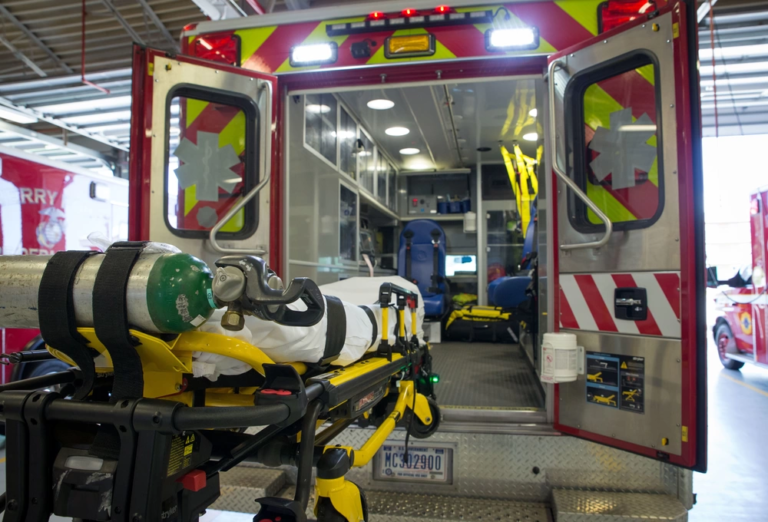
In American English, a gurney is a common name for a wheeled stretcher used to move patients. Cambridge Dictionary3 marks it as a U.S. term. You might also hear hospital stretcher, transport stretcher, or patient trolley. “Gurney bed” is an understandable search phrase: from the corridor, it can look like a bed on wheels.
Stretcher is the broader term. A folding stretcher that a rescue team carries by hand is still a stretcher, but it isn't what most people mean by a hospital gurney. And while people may also call an ambulance cot a gurney, that name tells you nothing about whether an indoor stretcher can be secured in a vehicle. For that separate comparison, see our guide to hospital transfer trolleys and ambulance cots.
Getting through the elevator door is only half the trip
If you’re comparing models, ask for the overall footprint with the accessories the team uses, not just the mattress dimensions. Look at the turn into the elevator, the space inside it once staff and equipment are aboard, and the turn into the receiving bay. A narrower stretcher may help on a tight route. If the hospital has a suitable bed elevator and the receiving area can accommodate the bed, downsizing the equipment for a single trip may add a transfer the care team didn’t need. Some beds are built with that trip in mind: the Stryker ProCuity operations manual4 includes in-facility transport as well as patient positioning, support and recovery.
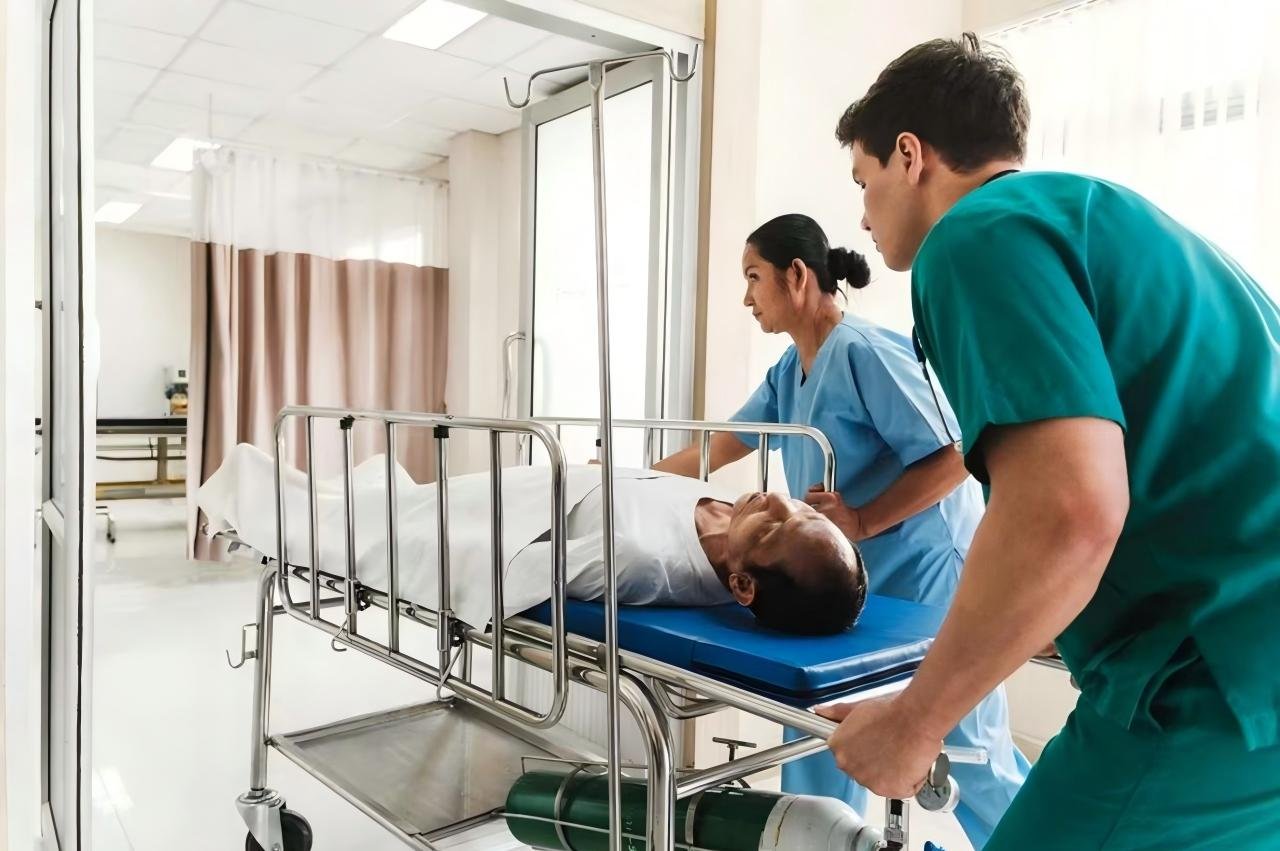
Then there’s the trip that fits all the way to the door and still needs a handoff. The UC San Diego Health MRI safety policy5, for example, specifies a nonmagnetic wheelchair or gurney for patients who can’t walk into the MR environment. If MRI is part of the route, ask the imaging department where its approved equipment takes over. A claim about X-ray use tells you nothing about whether a device is suitable for that MR environment.
Sometimes the better equipment swap is no swap at all
In one outpatient hand-surgery study6, the center used a specialized hand table that attached to a stretcher. Patients could stay on the same stretcher from the preoperative area through surgery and into recovery. In the two procedures studied, the median time from operating-room entry to procedure start and from procedure finish to room exit each fell by two minutes. That’s one center and a specific setup, not a promise that a standard transport stretcher can replace an operating table. The useful question for buyers is simpler: how many times does the proposed equipment make the team move the patient from one surface to another?
Why not buy more gurneys instead of hospital beds?
Put two quotes next to each other and it’s easy to compare the features they share: adjustable height, side rails, a padded surface and four wheels. Look again at the part that will get the most use.
On a ward bed, I'd look first at the support surface and positioning features the unit actually uses during a stay. If nurses need particular controls or the unit requires a specific mattress configuration, I'd ask the supplier to identify what comes on the quoted bed and what is optional. A spec sheet that says “adjustable” won't answer either question.
On a transport stretcher, I'd look at the trip as it happens, with the equipment the team actually takes. A stretcher that turns neatly in a showroom may take up more room in a bay once the IV pole and approved accessories are in place. And if it will make repeated trips between departments, I'd want to know where it gets cleaned, how it returns to service, and who stocks the parts that wear out.
A stretcher can still be used for care when it’s designed for it. Baxter’s instructions for Hillrom transport, procedural and specialty stretchers7 include indoor treatment and transport. By contrast, the Stryker Prime Series stretcher manual8 excludes long-term inpatient treatment and recovery for that series. If a gurney will double as a procedure or recovery surface, check the actual model before writing that assumption into the purchase.
Why a spare gurney doesn't give the hospital another inpatient bed
Someone in the emergency department can already have a decision to admit and still be waiting for an inpatient place. An observational study of emergency department boarding9 measured that wait after the admission decision. Here the bottleneck is an available inpatient place, not necessarily the number of stretchers the hospital owns. Keeping a spare gurney ready can help the transport fleet stay available. It doesn't create a staffed place on the ward.
The bit that gets missed: where the two meet
The ward can buy a perfectly good bed, and transport can buy a perfectly good gurney. Then the two turn up beside each other in a bay with barely enough room for the people who need to work there.
When reviewing a purchase, I'd have the teams look at one frequent route from start to finish, including any point where the patient changes surfaces. Can both units be positioned in the available space with their accessories attached? Has the facility already approved a transfer aid for that pair of surfaces? The Facility Guidelines Institute’s patient handling and mobility assessment guide10 treats a transfer between surfaces separately from moving a patient on a transport device. That distinction is useful when different departments are writing separate specifications.
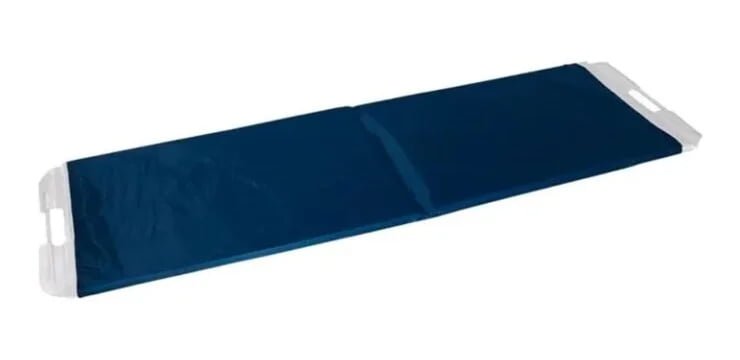
A patient transfer sheet is an example of a separate aid a facility may evaluate for that handoff. It doesn't replace the bed or the gurney, and a product listing alone can't confirm that a particular pairing is suitable.
What I’d put in the buying brief
- For a ward bed: Name the care unit, the required support surface and positioning, and any controls or options the ward needs. Ask for the supplied configuration in writing.
- For an in-hospital gurney: Name the main routes and whether it is also expected to support procedures or recovery. Ask for the overall size with the quoted accessories. Check the tightest elevator and turn on a frequent route with that configuration. Include cleaning instructions and parts availability.
- For the handoff: Identify the busiest place where the two meet and ask both teams to review the proposed configurations there. If the facility already has approved transfer equipment, make that part of the review instead of assuming it will fit.
The next time you see a bed and a gurney side by side, look past the wheels. One may have to serve the same patient through a shift, a night or several days. The other may have to be ready for the next trip before the bed upstairs is even free. That’s why hospitals often need both, and why a buying brief for one should never be copied straight onto the other.
“Engineering Services Guideline,” Section 17.8, NSW Health. Lists example equipment footprints and separates door opening, cabin size, and room for staff and equipment. ↩
“Beds, Mattresses, Patient Trolleys and Treatment Chairs”, HealthShare Victoria. Lists separate purchase categories for acute beds and patient trolleys. ↩
“Gurney”, Cambridge Dictionary. Identifies the U.S. usage and explains the term. ↩
“ProCuity Bed Series Operations Manual”, Stryker. Describes care and in-facility transport as intended uses for this bed series. ↩
“MRI Safety Policy”, UC San Diego Health. Describes the facility’s requirements for transport equipment in the MR environment. ↩
“The Effect of Stretcher-Based Hand Tables on Operating Room Efficiency at an Outpatient Surgery Center”, Orthopaedic Journal at Harvard Medical School. Reports workflow results from one center and two hand surgery procedures. ↩
“Hillrom Transport, Procedural, and Specialty Stretchers: Instructions for Use”, Baxter. Describes indoor treatment and transport for the listed stretchers. ↩
“Prime Series Stretcher Operations Manual”, Stryker. States the series is not intended for long-term inpatient treatment and recovery. ↩
“Emergency Department Boarding: A Descriptive Analysis and Measurement of Impact on Outcomes”, Canadian Journal of Emergency Medicine. Examines waiting after a decision to admit; it does not compare beds and stretchers as devices. ↩
“Patient Handling and Mobility Assessments”, Facility Guidelines Institute. Defines surface-to-surface transfer separately from transport. ↩