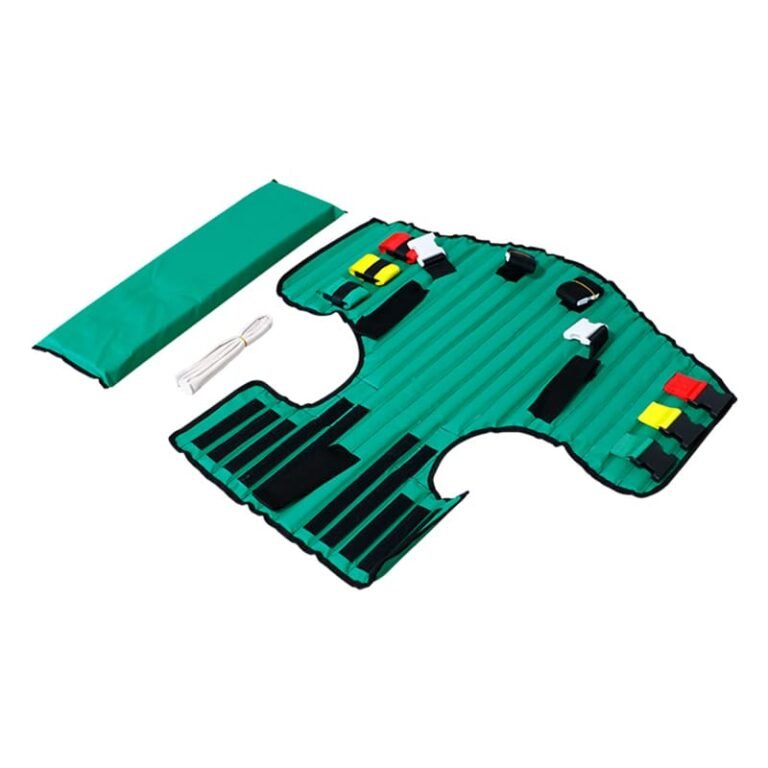
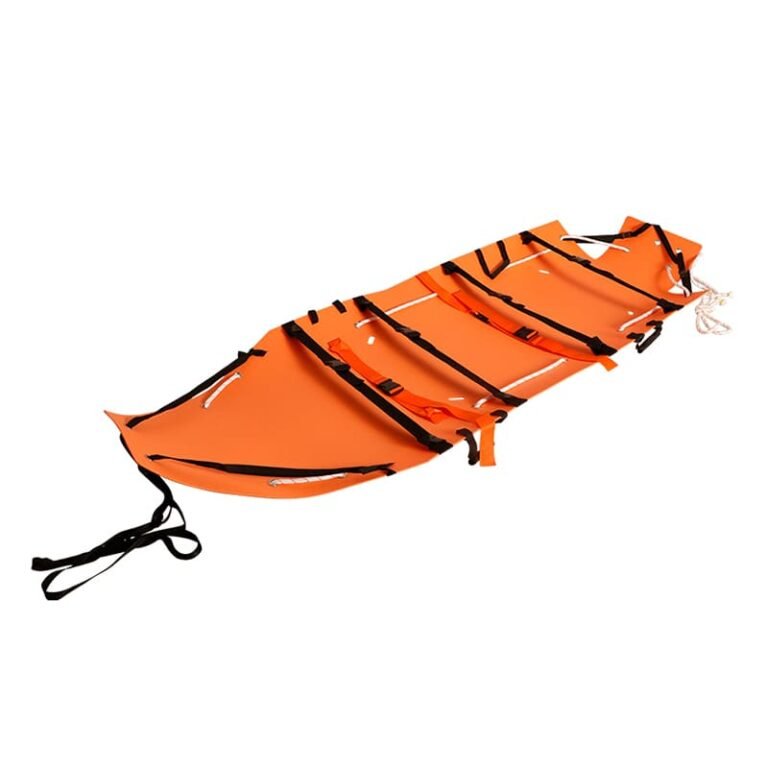
This Neil-Robertson stretcher is designed for safe, compact patient evacuation in confined and vertical environments such as ships, mines, and construction sites. Based on the marine rescue stretcher recommended in the International Medical Guide for Ships, it wraps around the patient and allows controlled lifting through narrow hatches, ladders, and vertical shafts where standard stretchers cannot be used.
The stretcher uses an internal frame of bamboo slats with a durable canvas cover, providing a flexible yet supportive structure. Multiple securing straps across the chest, hips, and legs wrap the patient firmly, while dedicated slots accommodate the arms. Foot-end loops connect to hoisting equipment so the stretcher can be lifted horizontally or vertically, with a rated safe working load of 120 kg in both positions.
When not in use, the stretcher folds into a compact bundle for easy storage on board ships or in rescue vehicles. The canvas surface offers good anti-slip performance and can be wiped down and disinfected after use. Its simple, mechanical design requires no power and is well-suited to harsh, remote environments.
Key Advantages:
-
Conforms to marine medical guidance: designed according to the Neil-Robertson stretcher recommended in the International Medical Guide for Ships
-
Wraparound canvas design with bamboo slats: provides secure support while remaining flexible for confined spaces
-
Horizontal and vertical lifting capability: safe working load up to 120 kg in both orientations
-
Multiple safety straps and foot loops: stabilize chest, hips, and legs for safer hoisting
-
Compact foldable structure: easy to stow in limited onboard or site storage space
-
Anti-slip canvas surface: helps reduce patient movement during lifting
-
Manual, power-free operation: reliable in remote or low-resource environments
-
Easy-to-clean, disinfectable materials for repeated professional use
Applications:
Merchant and naval vessels, offshore and port facilities, mining sites, construction projects, industrial plants, and emergency teams that need to evacuate casualties through hatches, ladders, shafts, or other confined vertical passages.