Two stretchers can list the same load capacity and still behave very differently at the back of an ambulance. One rolls in and locks. The other does not line up with the vehicle's floor fastener. A product photo will not tell you which one you are buying.
My short answer: Check the stretcher's size, rated load, loading height, vehicle fastener, handling features, and included parts before you place an order. Get the specifications for the exact model, then test a sample with the ambulance and crew that will use it.

Which Ambulance Stretcher Specifications Matter Most?
I would put these six questions on one sheet and ask every supplier to answer them for the same model:
| Specification | What to ask |
|---|---|
| Overall size | What are the unfolded and folded length, width, and height? How wide is the patient surface? |
| Rated load | What is the maximum load, and does it include the patient and attached equipment? |
| Loading setup | What loading height does the cot support? Where is that height measured? |
| Vehicle fit | Which floor fastener, safety hook, and patient restraints are specified for this cot? |
| Daily handling | How much does the empty cot weigh? How do the wheels, brakes, rails, and adjustments operate? |
| What is supplied | Which mattress, straps, fixing parts, manuals, and spare parts are included or available? |
The useful answer is a current datasheet or drawing, not “standard size” or “fits most ambulances.”
Will It Fit Your Ambulance and Lock in Place?
Start at the rear door. Measure the door opening and vehicle floor height, then identify the fastener already installed in the ambulance. Send those details to the supplier and ask for a drawing that shows how the proposed stretcher loads and locks.
Do not judge fit from the cot's overall length alone. Loading wheels, leg-folding movement, the rear step, and the position of the locking point all matter. A Stryker operating guide1 lists a specific maximum loading height and compatible fasteners for one model. Your cot needs its own matching figures and instructions.
If vehicle fit is the main uncertainty, our guide to ambulance stretcher dimensions goes into those measurements in more detail. Before a bulk order, I would still want to see a sample load and lock in the actual vehicle.
Is the Load Rating Right for Your Calls?
Check what the rating covers before you compare numbers. Does the stated limit include only the patient, or the patient plus equipment and accessories on the stretcher? The exact model's instructions should answer that.
For example, our YJK-A5-3 loading stretcher is listed at 159 kg, while the YJK-C-3 ambulance stretcher is listed at 180 kg. Those figures help you shortlist models. They do not replace a check of patient needs, loading equipment, and vehicle fit.
I covered the capacity decision in more detail in What Load Capacity Does an Ambulance Stretcher Need for Daily EMS Use?.
Can the Crew Use and Clean It Every Day?
The stretcher's own weight matters when crews move or load it. So do the small things they touch on every call: wheel brakes, side rails, backrest controls, straps, and release handles. Ask trained users to try the sample with gloves and in the space they actually work in.
Also look at the mattress cover and the places where dirt can collect. Ask which cleaning products the manufacturer permits and whether worn covers, wheels, straps, and latches can be replaced. A low purchase price becomes less attractive if a small damaged part takes the cot out of service.

What Exactly Comes With the Stretcher?
I would never leave “accessories included” as a vague line on a purchase order. List the mattress, patient restraints, fixing lock, IV pole, storage bag, and any other required parts one by one. Mark each item as included, optional, or unavailable for the exact model.
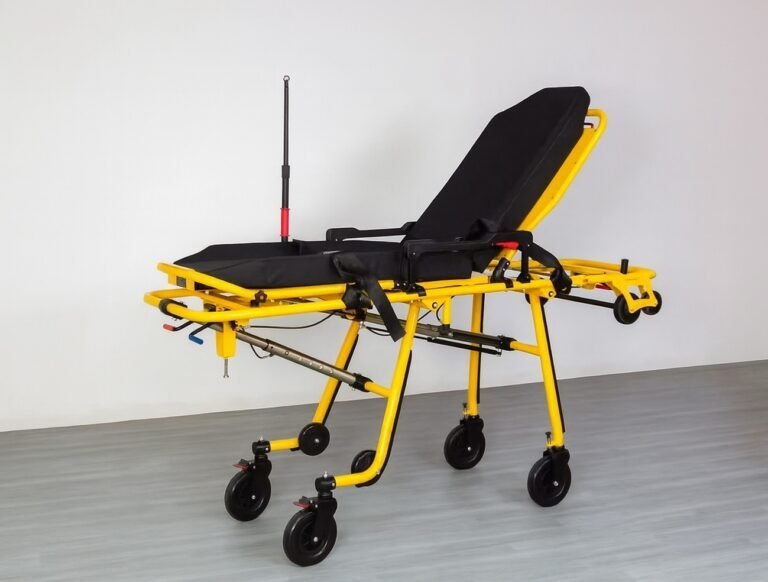
For instance, the YJK-H2-3 product page lists safety belts and a fixing lock among its accessories. That does not mean every stretcher includes the same package. If your team needs an IV pole, extra restraints, or other accessories, give the supplier your list before ordering and ask what is available and compatible with the exact model. Request an itemized list and confirm that any supplied fixing lock matches the vehicle.
Which Documents Should You Request Before Ordering?
Ask for a current model-specific datasheet, instructions for use, dimensioned drawings, accessory list, cleaning guidance, and spare-parts list. If approval or testing is important for your destination market, request the applicable records for the exact stretcher and fastening arrangement.
Standards can help frame the questions. EN 1865-12 covers general stretcher systems and patient-handling equipment in road ambulances. SAE J30273 addresses the litter, retention system, and patient restraint together. A general claim that a product is “compliant” is not enough; ask which model and components the documents actually cover.
My Final Check Before a Bulk Order
I would approve a sample only after the team can answer three questions: Does it fit and lock in the ambulance? Is its rated load suitable for the service? Can crews operate, clean, and maintain it with the parts supplied?
If any answer is still based on an assumption, get the drawing, manual, or sample test first. That is much easier than discovering a mismatch after the stretchers arrive.
Frequently Asked Questions
What is the most important stretcher specification?
There is no single winner. Vehicle loading and fastener compatibility, rated load, and patient fit have to work together. A strong cot that cannot lock into the ambulance is still the wrong cot for that vehicle.
Is a higher load capacity always better?
It gives more stated load allowance, but the cot also has to suit the crew, vehicle, and usual patients. Compare the complete system rather than one number.
Can I use my existing ambulance floor lock?
Only if the exact stretcher and fastener are confirmed compatible. Ask for the manufacturer's matching details and test the combination in the vehicle before ordering a fleet quantity.
[Stryker ambulance cot operating guide](https://techweb.stryker.com/EMS/Ambulance_Cots/6080/0011/6080-090-017B.pdf), example of model-specific vehicle and fastener requirements. ↩
[EN 1865-1 overview](https://www.nen.nl/en/nen-en-1865-1-2010-a1-2015-en-207606), NEN. ↩
[SAE J3027 overview](https://saemobilus.sae.org/standards/j3027_202206-ambulance-litter-integrity-retention-patient-restraint), SAE International. ↩