When buyers compare PVC and PEVA body bags, they usually want a simple answer: Which material is better?
For cold storage, PEVA is often the easier choice because it usually stays flexible at lower temperatures. PVC can also work well, and it is widely used for durable, flexible bags. But the material name does not tell the whole story. A bag also depends on its thickness, seams, zipper, handles, and tested load capacity.
So the practical answer is this: choose PEVA when cold flexibility or a PVC-free specification is the main concern. Choose PVC when the exact bag has the strength, temperature range, and construction you need. For either material, compare the finished bag rather than the plastic name alone.
What Is the Difference Between PVC and PEVA?
PVC is naturally a hard plastic. To turn it into a soft film, manufacturers add plasticizers. The choice of plasticizer affects how flexible the PVC feels and how it behaves in hot or cold conditions. The European Council of Vinyl Manufacturers1 gives a clear overview of how these additives change PVC performance.

PEVA is made from ethylene and vinyl acetate. It does not need the same plasticizer system to become flexible, and its main polymer structure contains no chlorine. The amount of vinyl acetate changes how soft and flexible the material is, which is why two PEVA films can still perform differently. Dow's ELVAX™ 460 data2 show how one EVA grade is specified.

| Point to compare | PVC | PEVA |
|---|---|---|
| How it becomes flexible | Plasticizers are added | Flexibility comes from the EVA-based material blend |
| Cold conditions | Performance depends strongly on the formulation | Often stays flexible at lower temperatures |
| Warm conditions | Can soften as temperature rises | Can also soften as temperature rises |
| PVC-free purchasing | No | Yes, for the main PEVA film |
| Finished-bag strength | Depends on the whole construction | Depends on the whole construction |
One useful difference is clear: PEVA can meet a requirement for a PVC-free main film. That does not automatically mean it is biodegradable or suitable for every disposal method. Those are separate questions.
Which Material Works Better in Cold Storage?
Cold makes some plastics stiff. A body bag that feels flexible at room temperature may become harder to unfold, close, or handle after hours in a freezer. Folds and zipper areas can also become more vulnerable when the film loses flexibility.
PEVA usually has the advantage here. Thermo Fisher Scientific's EVA film data3 show low-temperature brittleness values between about -59°C and -80°C. Mopec's PEVA body bag specification4 states that the bag remains flexible at -70°F, or about -57°C.
These figures do not mean every PEVA bag has the same rating. They show why PEVA is often considered first for frozen storage.
PVC performance varies more because the plasticizer system plays a large role. Ordinary flexible PVC may stiffen in deep cold, while a cold-resistant formulation can perform much better. For example, Hallstar's Plasthall® 297 technical data5 list a brittle point of -53°C for the cited PVC formulation.
For a refrigerated mortuary, either material may be suitable. For deep-freeze storage, ask for the minimum temperature of the exact bag. A clear figure such as “remains flexible at -40°C” is more useful than a general phrase such as “suitable for cold rooms.”
What Happens at High Temperatures?
Heat is sometimes ignored because body bags are usually discussed in relation to cold rooms. But bags can also sit in a hot vehicle, container, warehouse, or temporary field facility.
Both PVC and PEVA become softer as temperature rises. The zipper, welded seams, handle attachments, or labels may also weaken before the film itself fails.
An EVA resin may have a laboratory melting point that sounds high. For example, Dow's ELVAX™ 460 data2 list a melting point of 88°C. Mopec's PEVA body bag specification4 lists a maximum-use temperature of 180°F, or about 82°C. These numbers describe different products. A resin melting point is not the same as the safe working temperature of a complete body bag.
PVC does not have one fixed temperature limit either. The European Council of Vinyl Manufacturers' overview of PVC plasticisers1 explains why its behavior changes with the plasticizer system, including resistance to heat and cold.
If high temperatures are possible, ask the supplier two simple questions:
- What is the maximum temperature for continuous use?
- What temperature can the finished bag tolerate for a short period?
The answer should cover the complete bag, including the seams, zipper, and handles.
Is PVC or PEVA Stronger?
Neither material is automatically stronger. A well-made PEVA bag can be stronger than a lightly made PVC bag, and the opposite can also be true.
The weakest part is often not the middle of the film. Failure may begin where a handle is attached, where a seam meets a corner, or where a zipper puts stress on the material.

When comparing strength, look at five things:
- Film thickness: thicker film may improve durability, but thickness alone is not enough.
- Puncture and tear resistance: important when sharp objects, debris, or bones may press against the bag.
- Seams: welded or sealed areas must stay closed when the bag is lifted.
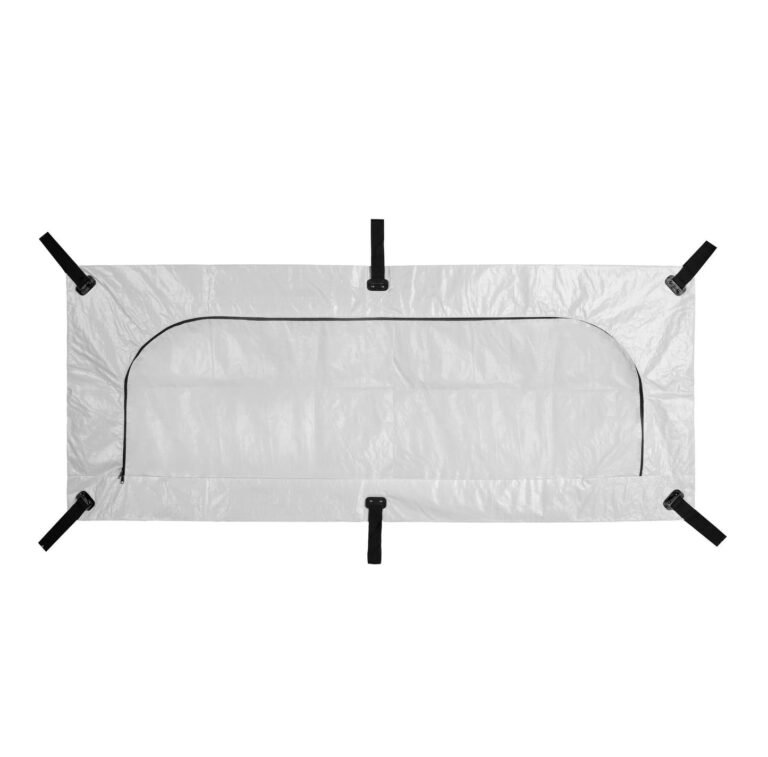
- Handles: the attachment points should spread the load instead of pulling on a small area of film.
- Finished-bag load rating: the rating should apply to the complete bag, not only to a material sample.
The CDC's archived postmortem handling guidance6 also tells users to consider body weight, sharp objects, fluid leakage, storage damage, and the manufacturer's stated capacity.
Which Material Fits Each Application?
| Application | Practical starting point |
|---|---|
| Routine hospital or mortuary transfer | Either PVC or PEVA, provided the size, load rating, and construction are suitable |
| Refrigerated storage | Either material may work; confirm the stated minimum temperature |
| Frozen storage | PEVA is often the easier starting point because of its cold flexibility |
| Field recovery or disaster response | Focus on puncture resistance, reinforced handles, seams, and the finished-bag load rating |
| PVC-free purchasing policy | PEVA is the usual choice for the main film |
| Hot vehicles or warm storage | Ask for continuous-use and short-exposure temperature limits for the finished bag |
For normal hospital use, the best choice may simply be the bag that fits existing trolleys, cold-room trays, and handling procedures. For field recovery, stronger handles and puncture resistance may matter more than whether the label says PVC or PEVA.
Six Questions to Ask Before Ordering
You do not need a long technical report to compare two body bags. Start with these questions:
- What are the bag's length, width, and film thickness?
- What is the tested load capacity of the finished bag?
- What are the minimum and maximum use temperatures?
- How are the seams made and tested for leakage?
- How many handles are fitted, and how are they reinforced?
- Has the finished bag been tested for tearing or puncture resistance?
These answers tell you much more than the words “PVC,” “PEVA,” or “heavy duty” on their own.
Frequently Asked Questions
Is PEVA always better than PVC?
No. PEVA is often better suited to very cold conditions and PVC-free purchasing. A well-constructed PVC bag may still be stronger or more suitable for a particular job.
Does PEVA stay flexible in a freezer?
PEVA is commonly chosen for freezer use because EVA-based films can remain flexible at very low temperatures. Check the rating of the exact bag before ordering.
Which material is better in hot conditions?
There is no single winner. Both materials soften with heat, and the zipper or seams may set the real limit. Compare the finished products' temperature ratings.
Does thicker film always mean a stronger bag?
No. Thickness helps, but weak seams, handles, or zippers can still cause the bag to fail.
Is PEVA biodegradable?
Not automatically. PEVA is PVC-free in its main polymer structure, but “PVC-free” and “biodegradable” are different claims.
Final Takeaway
PEVA is often the better starting point for frozen storage or a PVC-free purchasing policy. PVC remains a practical choice for many hospitals, mortuaries, and transport situations when the bag has the right formulation and construction.
The most important comparison is still the finished bag. Check its temperature range, load rating, seams, zipper, handles, and puncture resistance. Those details tell you how the bag will perform when it is actually used.
Sources
[“PVC Plasticisers”](https://pvc.org/about-pvc/pvc-additives/plasticisers/), European Council of Vinyl Manufacturers. Flexible PVC, plasticisers, and resistance to heat and cold. ↩
[“ELVAX™ 460 Ethylene Vinyl Acetate Copolymer”](https://www.dow.com/en-us/pdp.elvax-460-ethylene-vinyl-acetate-copolymer.1893117z.html), Dow. Composition and melting-point data for one EVA resin grade. ↩
[“Labtainer Bioprocess Container Film Data”](https://www.fishersci.ca/content/dam/fishersci/en_US/documents/programs/scientific/brochures-and-catalogs/brochures/labtainer-bioprocess-data-sheet-21-0309.pdf), Thermo Fisher Scientific. Low-temperature test data for specific EVA films. ↩
[“CF PEVA Envelope Style Body Bag BE066”](https://www.mopec.com/product/cf-peva-enevelope-style-body-bag-36-be066-2/), Mopec. Temperature range for one finished PEVA body bag. ↩
[“Plasthall® 297”](https://www.hallstarindustrial.com/product/plasthall-297/), Hallstar. Low-temperature data for a specialty plasticizer used in the cited PVC formulation. ↩
[“Collection and Submission of Postmortem Specimens”](https://archive.cdc.gov/www_cdc_gov/coronavirus/2019-ncov/hcp/guidance-postmortem-specimens_1720465699.html), CDC archive. Risks involving puncture, weight, leakage, storage damage, and bag capacity. ↩