When buyers ask me, “Which is better, a traction splint or a vacuum splint?” I usually have to slow the conversation down a little.
They may both be carried in an ambulance, and both are used to support injured limbs. But they do not do the same job.
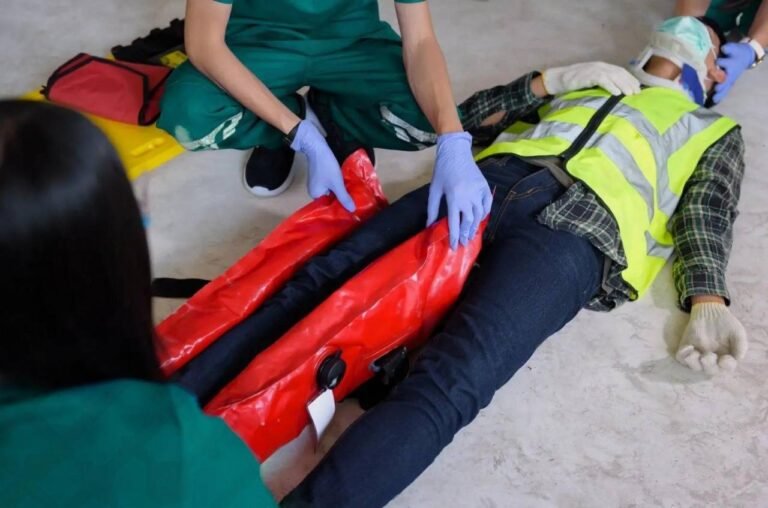
A traction splint is a specialist. It applies controlled traction and is considered for selected suspected femoral shaft injuries. A vacuum splint is more adaptable. It starts soft, molds around a limb, and becomes firm after air is removed.
The short answer: If your team needs a device for a specific, protocol-approved femoral traction role, look at a traction splint. If it needs close-fitting support for a wider range of selected limb injuries, a vacuum splint may be more useful. Many EMS and rescue teams may need both.
That is the simple version. The useful answer also depends on injury location, training, storage, cleaning, missing parts, and whether the device is still ready when the next call comes in.
This article is written for trained EMS, rescue, healthcare, and procurement teams comparing equipment. It is not patient-specific treatment advice. Clinical use should follow local protocols and the instructions for the exact device.
If you first want a broader overview of rigid, moldable, vacuum, traction, plaster, and fiberglass designs, see our guide to types of medical splints.
What Is the Difference Between a Traction Splint and a Vacuum Splint?
The easiest way to remember the difference is this:
- A traction splint applies a controlled pulling force along the injured leg.
- A vacuum splint wraps and conforms around the injured area, then becomes firm.
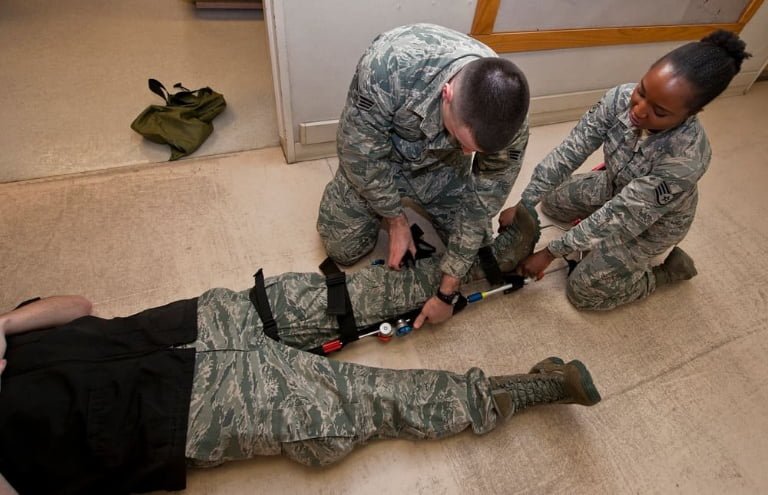
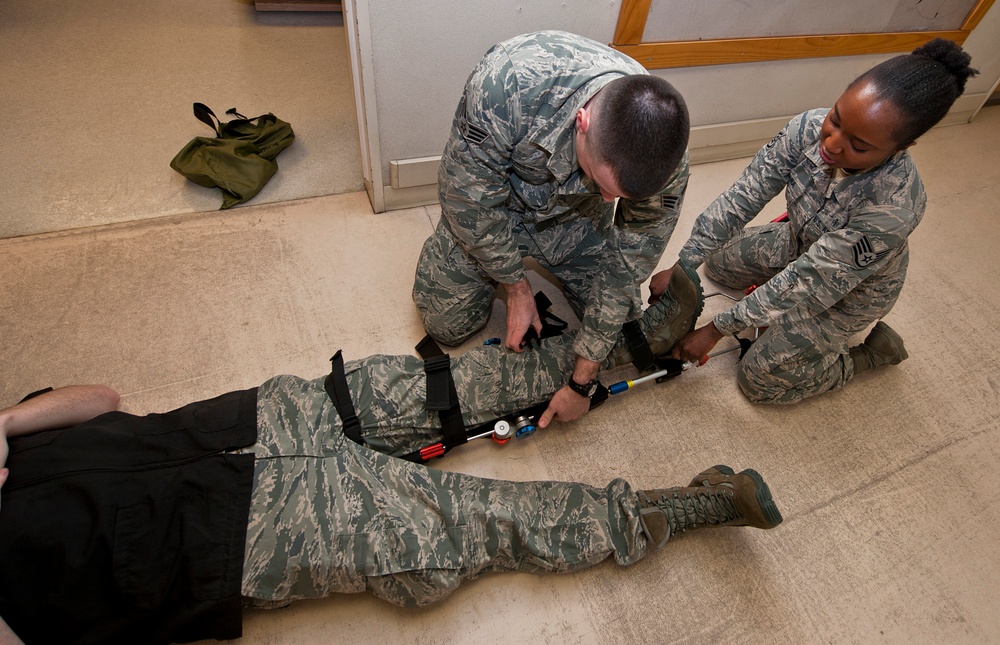
A traction splint normally uses a frame, straps, attachment points, and a traction mechanism. It is not simply a long rigid splint. Correct patient selection and correct adjustment are a large part of using it safely.
A vacuum splint contains small beads inside an airtight cover. While air remains inside, the beads can move and the splint is flexible. After the splint is shaped around the limb, a pump removes the air. The beads compact together and hold the molded shape.
Here is the practical comparison I use when discussing the two products:
| What to compare | Traction splint | Vacuum splint |
|---|---|---|
| Main action | Applies controlled longitudinal traction | Molds around the limb and becomes firm after air removal |
| Typical role | Selected suspected femoral shaft injuries | Selected fractures and joint injuries of different limbs |
| Key parts | Frame, traction mechanism, supports, straps, and attachment points | Airtight cover, beads, valve, pump, hose, and straps |
| Main training concern | Patient selection, assembly, traction, and reassessment | Molding, pumping, securing, and leak monitoring |
| Common readiness problem | A missing strap or attachment, damage, or unsuitable size | A puncture, leaking valve or seam, or incompatible pump |
| Storage question | Will the complete device fit the vehicle compartment? | Can the splint be protected from sharp objects and stored with its pump? |
The last two rows are easy to overlook. A product can look excellent in a catalog and still create problems if one small part is missing or the packed kit does not fit the ambulance.
When Is a Traction Splint Used?
I think of a traction splint as a focused tool. Conventional femoral traction splints are mainly associated with selected suspected fractures of the femoral shaft. When the device is appropriate and correctly applied by trained personnel, controlled traction may help stabilize the injured thigh and reduce muscle spasm and pain during transport.
The words “selected” and “suspected” matter here. A traction splint is not a general answer for every painful leg injury or every femur fracture.
For example, the UK NICE guideline on complex fractures1 says that prehospital responders should consider a traction splint, or the adjacent leg as a splint, for a suspected long-bone fracture above the knee. This is guidance for a defined clinical setting. It should not be turned into a universal rule for every service, country, patient, or product.
The injury location also changes the decision. The Merck Manual procedure for applying a femoral traction splint2 lists a femoral shaft fracture as the indication and identifies pelvic fracture, injury to the knee on the same side, and fractures of the lower leg, ankle, or foot on the same side as contraindications.
Different traction splint designs are assembled and adjusted differently. A team that knows one model should not assume a second model works in exactly the same way.
When I compare traction splints for a buyer, these are the questions I would ask first:
- What patient height and leg-length range can the exact model accommodate?
- Is a separate pediatric size needed?
- Are every strap, support, attachment, and adjustment part included?
- Are the adjustment points easy to identify while wearing gloves?
- Can the team practice with the same model it will carry?
- What are the packed dimensions, and where will the complete kit be stored?
“Compact” is useful only when the device remains complete, easy to assemble, and clear to operate.
When Is a Vacuum Splint Used?
A vacuum splint solves a different problem. Its main strength is close contouring.
Before the air is removed, the splint is flexible enough to be shaped around the supported area. After evacuation, it firms around that shape. This can make it practical for selected injuries involving the lower leg, ankle, arm, or a joint, depending on the clinical assessment, local protocol, and device instructions.
The NICE recommendation on complex fractures1 also says to consider a vacuum splint for other suspected long-bone fractures of the leg when the suspected fracture is not above the knee. Again, this is a useful example of how injury location affects equipment choice, not a universal treatment rule.
Vacuum splints often look simple, but the whole system has to work together. The cover must hold air, the valve must close correctly, and the pump and hose must fit. If any one of those parts fails, the splint may slowly soften.

This is why I would ask more than “What material is it made from?” before ordering:
- How should the team check air retention before the device returns to service?
- Is the pump compatible with every splint size in the kit?
- Can the valve be used easily with the intended gloves?
- Which cleaning products are compatible with the cover?
- Must the splint be completely dry before storage?
- Can valves, hoses, pumps, straps, and repair materials be ordered separately?
Claims such as “waterproof,” “cold resistant,” or “suitable for water rescue” should be checked for the exact model. The words “vacuum splint” alone do not prove those features.
Common Problems That Appear in Real Equipment Use
Product pages usually show a clean device with every part in place. Daily equipment management is less tidy. These are the problems that can decide whether a splint is actually useful:
A traction splint is stored with one part missing
The frame may still look like a complete product in a quick visual check. But if an attachment, support, or strap is missing, the system may not be ready. A simple component checklist inside the storage bag can make missing parts easier to notice.
A vacuum splint feels firm at first and then softens
A tiny puncture, damaged seam, or poorly closed valve may not be obvious. A written inspection and air-retention process is more reliable than judging the cover by appearance alone.
The label says “adult,” but the usable range is unclear
“Adult size” is not a measurement. Buyers should ask for usable dimensions, adjustment range, strap positions, and any limits stated by the manufacturer.
The team has read the manual but has not handled the device
Reading helps, but hands-on practice shows where parts become confusing. Users should train with the exact model they will assemble, apply, reassess, remove, clean, inspect, and repack.
Straps or the frame make reassessment awkward
The American Red Cross Emergency Medical Response manual3 includes checking circulation and sensation beyond the injury after splinting. The device and strap layout should allow the reassessments required by the team’s protocol.
These details are not exciting, but they are where a low-priced product can become expensive. Replacing missing parts, managing leaks, or retraining people on an unclear design costs time as well as money.
Can a Vacuum Splint Replace a Traction Splint?
Not as a general rule.
A vacuum splint molds around a limb and limits movement, but it does not create the same controlled longitudinal traction as a femoral traction splint. A traction splint has a much narrower role and is not a general-purpose solution for every lower-limb injury.
For some services, the sensible equipment plan is to carry both: a protocol-approved traction device for its specific role and vacuum splints for other selected limb-immobilization needs.
It is also easy to compare the wrong products. A limb vacuum splint and a full-body vacuum mattress both use air removal, but they support different areas of the body and solve different handling problems. Findings about a vacuum mattress should not automatically be applied to a limb splint.
There is limited evidence for naming one whole splint category the winner in every setting. An evidence review from the International Commission for Mountain Emergency Medicine4 notes the lack of randomized comparisons between splinting devices and discusses practical factors such as the body part, weight, cost, compatibility with other rescue equipment, and team familiarity.
That matches the practical answer: the best choice is the device that fits the intended clinical role and that the team can keep complete, inspect, carry, and use correctly.
What Should Buyers Compare Before Ordering?
Unit price is easy to compare, so it often receives too much attention. I prefer to compare each product as a complete working system.
| Procurement question | What to verify |
|---|---|
| Intended use | Injuries, body areas, trained user group, care setting, and local protocol |
| Size range | Usable dimensions, adjustment range, and adult or pediatric options |
| Complete kit | All straps, supports, attachments, pumps, hoses, bags, and accessories |
| Gloved operation | Valves, buckles, markings, adjustment points, and release mechanisms |
| Readiness checks | Visual inspection, functional testing, air retention, and component checklist |
| Cleaning and reuse | Compatible disinfectants, drying, inspection interval, and retirement criteria |
| Storage | Packed dimensions, sharp-object protection, vehicle position, and temperature limits |
| Training | Instructions for use, demonstration material, checklist, and practice equipment |
| Service support | Spare parts, repair policy, accessory compatibility, and replacement lead time |
| Documentation | Exact model identity, labeling, stated claims, and destination-market records |
Regulatory wording deserves a careful look too. ISO 13485 concerns a quality management system; it is not a blanket certificate proving the performance of every product. CE marking and United States requirements depend on the exact device and its classification.
The FDA explains that establishment registration and device listing do not mean a device is approved, cleared, or authorized5. If a supplier says only “FDA registered,” ask for the exact model information and the records that actually apply to that product and destination market.
Which Splint Should an EMS Kit Include?
I would start with the calls the team handles and the protocols it follows, then work backward to the equipment.
- Evaluate a traction splint first when the service needs a protocol-approved option for selected suspected femoral shaft injuries and has trained users for the exact model.
- Evaluate a vacuum splint first when close-fitting limb support is the main need and the service can inspect and maintain the cover, valve, pump, hose, and straps.
- Evaluate both when the team manages different patterns of lower-limb injury and its protocols give the devices separate roles.
Before a larger order, let trained users test a sample in the conditions they actually work in. Use the vehicle compartment, normal gloves, available lighting, and the real storage bag. Then record anything that slows down sizing, assembly, pumping, adjustment, cleaning, or repacking.
A few minutes of realistic testing can reveal more than a long specification sheet.
Frequently Asked Questions
Is a traction splint used for every femur fracture?
No. Conventional femoral traction splints have a limited role. The suspected injury pattern and injuries involving the pelvis, knee, lower leg, ankle, or foot can change whether one is appropriate. Trained personnel should follow local protocols and the Merck Manual guidance for the exact model and injury pattern2.
Can a vacuum splint replace a traction splint?
Not automatically. A vacuum splint provides molded support, but it does not reproduce the controlled longitudinal traction of a femoral traction splint. The two may have separate jobs in the same equipment plan.
Which splint is faster to apply?
There is no honest single answer for every model and every team. Assembly, sizing, molding, pumping, securing, user familiarity, and equipment readiness all affect the time.
What should be checked before a vacuum splint is placed in service?
Check the cover, seams, valve, hose, pump, straps, labels, and air retention according to the manufacturer’s instructions. Store the complete kit together and protect it from sharp objects.
What documents should a buyer request?
Ask for the instructions for use, specifications, labels, cleaning and inspection guidance, evidence supporting product claims, quality management documents, and the regulatory records required for the exact model in the destination market.
Final Takeaway
When someone asks me which splint is better, my answer is still: better for which job?
A traction splint is a specialized device for selected suspected femoral shaft injuries. A vacuum splint molds around a limb and supports a broader range of selected injuries. They overlap in the general idea of immobilization, but their mechanisms and roles are different.
For a buyer, the useful comparison goes beyond the product name. Look at the intended use, size range, training, complete accessory set, storage, inspection, cleaning, spare parts, and documents for the exact model.
The best equipment is not simply the one with the longest feature list. It is the one your team can understand, keep ready, and use correctly when it is needed.
[NICE, “Fractures (complex): assessment and management”](https://www.nice.org.uk/guidance/ng37/chapter/recommendations) — Guidance on prehospital splint selection for suspected leg fractures. ↩
[Merck Manual, “How To Apply a Femoral Traction Splint”](https://www.merckmanuals.com/professional/injuries-poisoning/how-to-splint-or-immobilize-a-lower-limb/how-to-apply-a-femoral-traction-splint) — An overview of common indications, contraindications, and precautions. ↩
[American Red Cross, “Emergency Medical Response Instructor’s Manual”](https://www.redcross.org/content/dam/redcross/delta/EMR_InstructorsManual_2017_LoRes_111017.pdf) — Training guidance on splinting and patient reassessment. ↩
[Sumann et al., “Multiple Trauma Management in Mountain Environments”](https://pmc.ncbi.nlm.nih.gov/articles/PMC7737289/) — A review of splint selection in rescue environments. ↩
[U.S. FDA, “Are There ‘FDA Registered’ or ‘FDA Certified’ Medical Devices?”](https://www.fda.gov/medical-devices/consumers-medical-devices/are-there-fda-registered-or-fda-certified-medical-devices-how-do-i-know-what-fda-approved) — Explains the difference between registration, listing, clearance, and approval. ↩