
When buyers ask me to recommend a tourniquet, I understand why they hope for a quick answer. The product is small, the basic structure looks simple, and many models appear quite similar in photographs. It is natural to compare the price, choose a color, and move on to the next item in the first-aid kit.
Still, a few extra questions at the beginning can prevent much larger problems later. Who is expected to use the tourniquet? Will it stay in a workplace cabinet, an ambulance, or a tactical pouch? Has the exact model been tested for the claimed application? Can the supplier keep the materials and construction consistent from one order to the next?
In my view, the most suitable tourniquet is not necessarily the most expensive or the most rugged-looking one. It is the model whose intended use, performance evidence, operation, storage requirements, and supply consistency match the buyer’s actual program.

Scope note: This guide discusses commercially manufactured, nonpneumatic limb tourniquets intended for life-threatening bleeding from an arm or leg. It does not cover bands used for blood collection or pneumatic tourniquets used during surgery. It is a purchasing guide rather than a clinical-use instruction. Users should receive appropriate training and follow local emergency procedures.
Start by Confirming the Intended Use
Before comparing materials or mechanisms, it helps to confirm that everyone is discussing the same type of product. The word tourniquet may refer to several devices:
- A phlebotomy tourniquet temporarily helps make a vein easier to access during blood collection.
- A surgical pneumatic tourniquet is used by trained clinical professionals during controlled procedures.
- An emergency limb tourniquet is intended to control life-threatening extremity bleeding.
These products have different purposes and should not be treated as alternatives to one another. The product specification, label, instructions, test reports, and quotation should all describe the same intended use.
American Red Cross guidance recommends a manufactured tourniquet as first-line therapy for life-threatening extremity bleeding1. The important words here are life-threatening and extremity. A tourniquet is one part of an emergency response plan; it does not replace calling emergency services, assessing the situation, or learning other bleeding-control methods.
How Do the Three Main Use Environments Differ?
The basic purpose remains the same, but the surrounding requirements can change considerably. A tourniquet carried by a trained tactical user has a different daily life from one stored in a factory cabinet.
| Use environment | Typical priorities | Useful questions |
|---|---|---|
| Emergency medical or rescue | Quick access, clear identification, compatibility with team procedures | Does it fit the existing response kit? Can gloved users open and identify it easily? Can the same model be reordered? |
| Tactical or field | Verified performance, compact carry, secure retention, environmental durability | Has it been evaluated for the required self-aid and buddy-aid applications? Does it remain usable after realistic storage and carrying? |
| Workplace first aid | Straightforward identification, training support, organized storage, multi-site consistency | Can infrequent users recognize it? Is it easy to inspect and replace? Can all sites use the same model and instructions? |
This comparison does not mean that one environment accepts a lower-performing product. Reliable bleeding control remains essential in every setting. The differences are mainly in access, packaging, training, storage, and program management.
Emergency medical and rescue kits
For an ambulance, rescue bag, industrial response station, or public bleeding-control cabinet, visibility and access deserve attention. A well-chosen tourniquet can still be difficult to use if it is hidden under other supplies or packed in an unfamiliar way.
When reviewing a sample, I usually suggest checking:
- Whether the product is easy to identify.
- Whether the package can be opened as intended while wearing gloves.
- Whether it fits the organization’s current bag or cabinet layout.
- Whether the instructions match the model used in training.
- Whether the model and lot can be checked without unnecessary handling.
- Whether replacement units will have the same design and operating steps.
The American College of Surgeons STOP THE BLEED® program2 teaches the public to respond to severe bleeding through several methods, including pressure, wound packing, and tourniquet use when appropriate. For buyers, this is a helpful reminder to plan the complete response system rather than purchase an isolated product.
Tactical and field deployment
A tourniquet carried in the field may spend months folded inside a pouch. During that time, it can be exposed to movement, dirt, moisture, sunlight, or temperature changes. It may then need to be used with limited visibility or movement.

In this environment, appearance alone provides very little information. Terms such as “military grade” or “combat style” are broad descriptions, so it is reasonable to ask what evidence supports them. The Joint Trauma System provides current TCCC guidance and links to CoTCCC-recommended devices and adjuncts3. If a specific recommendation is claimed, buyers can check whether the exact model and current version are included.
It is also useful to examine the packaged size, pouch fit, access orientation, component retention, label visibility, and stated environmental limits. These are practical details, but in field use practical details often matter greatly.
Workplace first-aid programs
Workplace procurement may look simpler, yet it often involves more locations and more users. A company may need to manage multiple factories, vehicles, warehouses, security stations, or construction sites. Staff turnover and different language requirements can add another layer of complexity.
For a workplace program, I would normally consider:
- One clearly identified model across locations.
- Separate units for training and emergency use.
- Instructions appropriate for the intended workforce.
- A routine inspection and replacement process.
- Clear model, lot, and date information.
- Stable specifications for future orders.
A slightly lower unit price may be attractive, but frequent changes in the buckle, label, packaging, or operating sequence can create extra work. Stable products are easier to train, inspect, replace, and manage across several sites.
What Performance Information Should Buyers Review?
This is usually the most valuable part of the comparison. Product photographs can show the general design, but they cannot show whether the tourniquet produces reliable arterial occlusion or remains secure after tightening.
Buyers do not need to become test engineers. A practical approach is to ask the supplier for the complete report and confirm five points:
- Which exact model was tested?
- What test method and acceptance criteria were used?
- Who carried out the evaluation?
- How many samples were included?
- Does the tested version match current production?

Arterial occlusion
The central performance question is whether the device can stop arterial flow on the limb sizes covered by its claim. If the model is promoted for use on both arms and thighs, the supporting evaluation should reflect both applications.
The CoTCCC’s comprehensive tourniquet review considered areas such as arterial occlusion, application speed, ease of use, pain, blood loss, durability, and device complications4. This gives buyers a useful framework for reviewing evidence without relying on a single material claim.
Limb-size range
Phrases such as “one size fits all” are easy to print but should be supported by a stated range. Ask for the minimum and maximum claimed limb circumference and the evidence behind that range. If the project has special requirements—for example, pediatric use, large thighs, or application over clothing—include them in the sample evaluation.
Self-application and application to another person
A product may be used differently in different programs. Tactical users may need one-handed self-application, while a workplace responder is more likely to assist another person. Testing in one application mode should not automatically be assumed to cover every other mode.
It helps to define the expected application before approving the product. The supplier can then provide relevant evidence, and the buyer can include the same scenario in user evaluation and training.

Application time and operating steps
A quick demonstration by someone who handles the product every day can be useful, but it may not represent a first-time or infrequent user. When possible, include representative users in the evaluation and observe where they hesitate, misroute the strap, or misunderstand the retention feature.
This is not about criticizing the user. Those moments often reveal where packaging, instructions, labeling, or training can be improved.
Security after tightening
After tightening, the windlass or other mechanism needs to remain in the intended position. Review the strap routing, buckle, stitching, hook-and-loop area, retention clip, and locking feature as a complete system.
If the product will be carried in a vehicle or tactical pouch, ask whether vibration, handling, movement, and relevant environmental exposure were considered. The conditions should be appropriate to the claim rather than added only for marketing effect.

Production consistency
The approved sample is only the beginning. Delivered products should continue to match it in materials, dimensions, components, assembly, labeling, and packaging.
A supplier can explain how it manages:
- Incoming materials and component suppliers.
- Critical dimensions and assembly steps.
- In-process and finished-product checks.
- Lot traceability.
- Nonconforming products.
- Product changes and buyer notification.
I find it helpful to approve not only the physical sample, but also the specification that defines it. This gives both buyer and supplier a clearer reference for future production.
How Should I Compare Windlass, Ratcheting, and Elastic Designs?
Each mechanism has its own operating method and inspection points. Rather than choosing by category alone, compare evidence for the exact model.
| Design | Features buyers may consider | Points to verify |
|---|---|---|
| Windlass | Familiar format and broad representation in training materials | Windlass strength, strap routing, retention, claimed application modes, and production consistency |
| Ratcheting | Incremental tightening and a mechanical locking action | Ratchet engagement, release protection, component durability, and user familiarity |
| Elastic wrap | Compact construction and a different wrapping method | Required stretch technique, secure fastening, limb-size range, and repeatable performance |
Two tourniquets can use the same type of mechanism and still perform differently. Webbing width, component geometry, materials, assembly, and user interaction all influence the finished system. This is why mechanism type is a starting point rather than a final decision.
Why Training Should Be Planned with the Product
Even a clearly designed tourniquet benefits from product-specific practice. In an emergency, the user may be working quickly, wearing gloves, or dealing with stress. Familiarity can reduce avoidable hesitation.
A study involving people without formal training found that first-time windlass tourniquet use often produced poor results, while prior experience was associated with more successful application5. The study does not answer every procurement question, but it does show why training deserves a place in the purchasing plan.
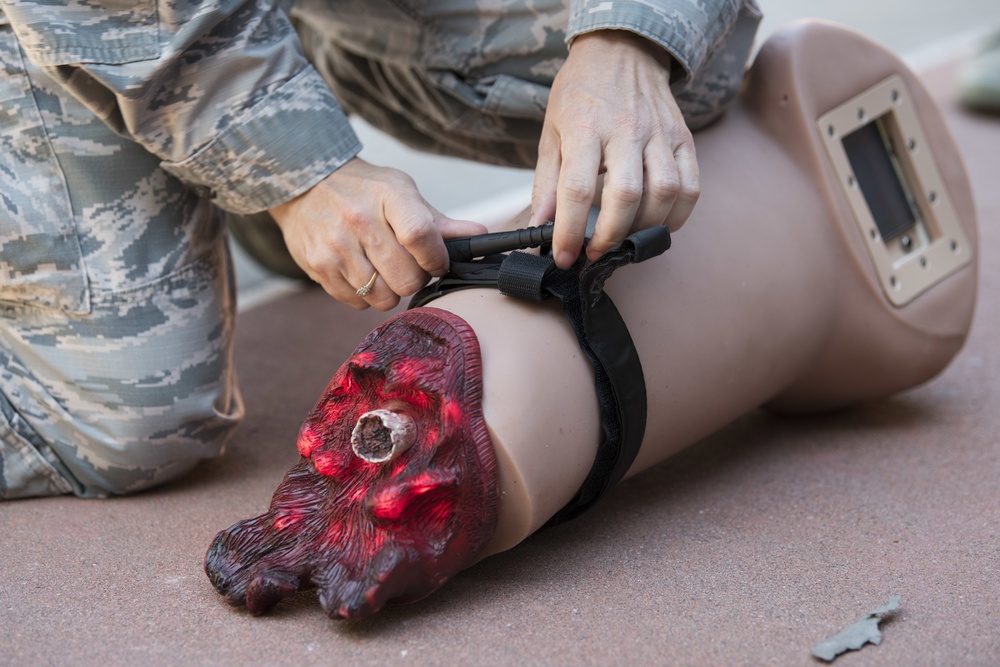
It is sensible to use the same model for training and emergency deployment so that the operating steps remain familiar. However, the physical units used repeatedly in training should be kept separate from operational stock. Practice can wear the strap, fastening surface, and other components or damage the package.
A simple training plan can define:
- Who receives initial and refresher training.
- Which model is used in practice.
- How the organization checks competence.
- Where operational units are stored.
- Who inspects and replaces them.
- How users are informed if the model changes.
What Should I Consider About Packaging and Storage?
The best packaging depends on where the product will be kept. A clear, visible pack may work well in a workplace cabinet. A compact configuration may be more suitable for a personal pouch. Additional layers are useful only when they provide necessary protection without making access unnecessarily difficult.

Before confirming the order, buyers can ask:
- Is the tourniquet supplied loose, pouched, or sealed?
- Can the intended user identify and open the package easily?
- What temperature, humidity, light, and handling limits apply?
- Is a shelf life stated, and what information supports it?
- Can the model, lot, and relevant dates be read clearly?
- Will private labeling preserve all required information?
Sterile packaging should not be requested only because it sounds more medical. If sterility is claimed or required, it should be appropriate and validated for the exact product and packaging configuration.
An inspection routine should follow the manufacturer’s instructions and local program requirements. Depending on the product, the check may include package integrity, contamination, visible damage, distorted hardware, missing components, unreadable labels, storage exposure, and replacement status.
What Documents Are Worth Checking?
Documentation is important, but it does not need to dominate the product discussion. I normally focus on a short set of useful records:
- Product specification and instructions for use.
- Performance or test reports for the exact model.
- Packaging, storage, and shelf-life information.
- Lot-traceability and quality-control information.
- Quality-system and market documents applicable to the project.
FDA, CE, and ISO 13485 refer to different regulatory or quality matters and should not be treated as interchangeable product certificates. For example, the FDA database currently identifies a nonpneumatic tourniquet under product code GAX as a Class I device that is generally 510(k)-exempt, subject to applicable limitations and requirements6.
For most buyers, the practical check is straightforward: confirm that each document matches the exact product, manufacturer, target market, and current date. If the market requirements are unclear, a qualified regulatory professional can confirm what is needed before import or sale.
A Practical Supplier Comparison
The following table keeps the supplier review focused on information that can be checked.
| Review area | What to request | What may need clarification |
|---|---|---|
| Intended purpose | Current specification, label, and instructions | Different intended uses appear across documents |
| Performance | Complete report with method, samples, results, and conclusion | The report covers another model or an older version |
| Materials | Controlled component specifications | Materials may change without defined approval criteria |
| Traceability | Model, lot, dates, and production records | Finished units cannot be linked to a production lot |
| Quality documents | Current documents with a clear scope | Company name, site, or product scope does not match |
| Change control | A defined notification and approval process | Critical components can change without notice |
| Supply continuity | Lead time, capacity, and repeat-order plan | Model or packaging varies from one order to the next |
| Private label | Controlled artwork and agreed responsibilities | Branding is added before required information is reviewed |
It is also helpful to compare the quotation with the approved specification. The model name, dimensions, materials, packaging, labeling, instructions, accessories, inspection plan, and carton configuration should be consistent across the order documents.
A Short Pre-Purchase Checklist
Before approving a tourniquet, I would work through these ten questions:
- Is it intended for life-threatening bleeding from an arm or leg?
- Who will use it, and what training will they receive?
- Where will it be carried or stored?
- Does performance evidence cover the claimed limb sizes and application modes?
- Does the report identify the exact current model?
- Does the tightening and retention system remain secure as intended?
- Are packaging, storage conditions, and shelf life clearly stated?
- Can the product be traced by model and lot?
- Do the documents match the manufacturer and target market?
- Will important material or design changes be communicated before delivery?
Not every buyer will use the same approval process, but these questions provide a calm and repeatable place to begin.
Frequently Asked Questions
What is the best tourniquet for emergency use?
There is no single model that is best for every program. Look for a commercially manufactured device supported by appropriate performance evidence, suitable training, clear instructions, and consistent supply for the intended environment.
Is a windlass tourniquet always the best choice?
Not automatically. Windlass, ratcheting, and elastic designs have different operating methods. The exact product’s performance, usability, security, limb-size range, and manufacturing consistency are more informative than the category name alone.
Should price be part of the decision?
Yes. Once minimum performance, quality, and documentation requirements are satisfied, price is a reasonable comparison factor. It is also worth considering training, replacement, packaging, and repeat-order consistency as part of the total cost.
Does ISO 13485 prove that a tourniquet performs well?
No. ISO 13485 relates to a medical-device quality-management system. Product-specific performance evidence and applicable market documentation still need to be reviewed separately.
Can training units be returned to emergency stock?
Repeated practice may wear or damage a unit. Keeping training units clearly separated from operational stock is generally a safer and easier management approach. Buyers should also follow the manufacturer’s inspection and replacement instructions.
Final Thoughts
Choosing a tourniquet becomes easier when the decision is divided into manageable parts. First confirm the intended use. Then consider the users and environment, review performance evidence, evaluate samples, plan training and storage, and check that the supplier can maintain the approved specification.
This process does not need to be confrontational or overly technical. Most good supplier discussions improve when the buyer explains the real application and asks clear, specific questions. The goal is simply to make sure that the product, evidence, and deployment plan support one another.
At JIEKANG, we can discuss product specifications, samples, packaging options, quality information, and project requirements where applicable. Sharing the target market, intended users, storage environment, quantity, and branding needs at the beginning can help make the evaluation more efficient for everyone involved.
[American Red Cross, *Focused Updates and Guidelines 2020*](https://www.redcross.org/content/dam/redcross/training-services/course-fact-sheets/American-Red-Cross-Focused-Updates-and-Guidelines-2020.pdf) — guidance on life-threatening extremity bleeding. ↩
[American College of Surgeons, *STOP THE BLEED®*](https://www.facs.org/media-center/resources-for-journalists/stop-the-bleed-resources-for-journalists/) — public bleeding-control education. ↩
[Joint Trauma System, *TCCC Guidelines*](https://jts.health.mil/index.cfm/committees/cotccc/guidelines) — current tactical casualty care resources. ↩
[CoTCCC, *Comprehensive Tourniquet Review*](https://jts.health.mil/assets/docs/cotccc/cotccc_meeting_minutes_2019_02.pdf) — tourniquet assessment criteria. ↩
[McCarty et al., *Windlass Tourniquet Use Without Formal Training*](https://pubmed.ncbi.nlm.nih.gov/31274827/) — simulated-use study. ↩
[U.S. FDA, *Nonpneumatic Tourniquet Product Classification*](https://www.accessdata.fda.gov/scripts/cdrh/cfdocs/cfPCD/classification.cfm?id=GAX) — product code GAX and classification. ↩