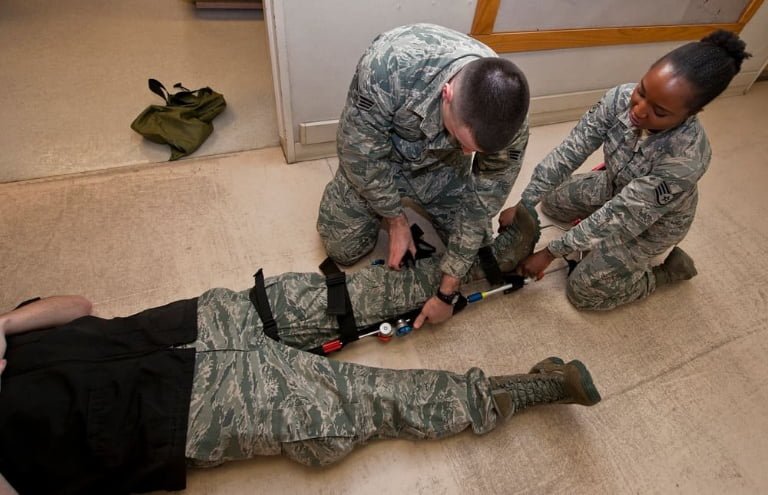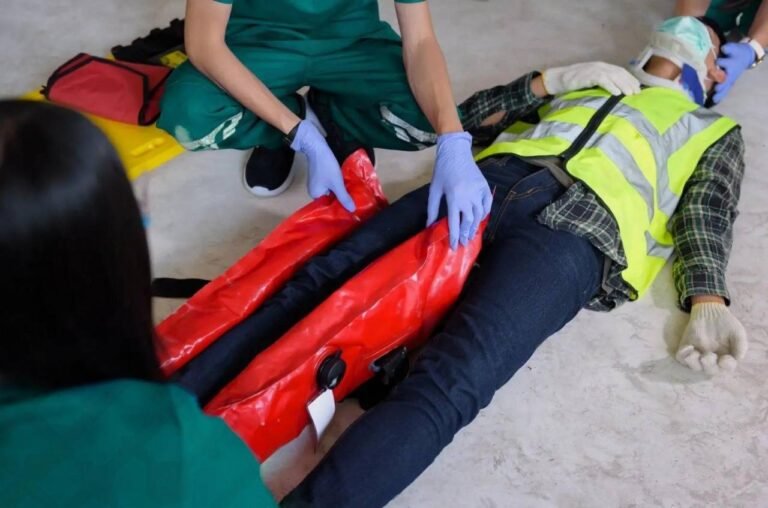
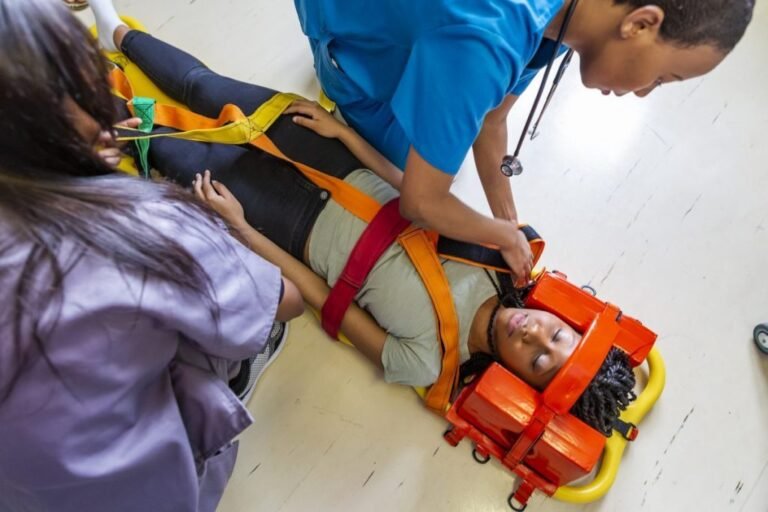
When buyers first see a head immobilizer, it can look like two foam blocks, a base, and a few straps. That description is not wrong, but it misses the important part: the device only makes sense when it works as part of a system.
A spine board supports the patient’s body and provides a firm mounting surface. The head immobilizer attaches to that surface and helps reduce side-to-side and rotational movement of the head.
The short answer: A head immobilizer is a device designed to help keep the head positioned relative to a spine board or compatible stretcher. Most designs use a base plate, two side blocks, and forehead and chin straps. It does not replace proper patient assessment, manual stabilization, a cervical collar, body straps, or local protocol.
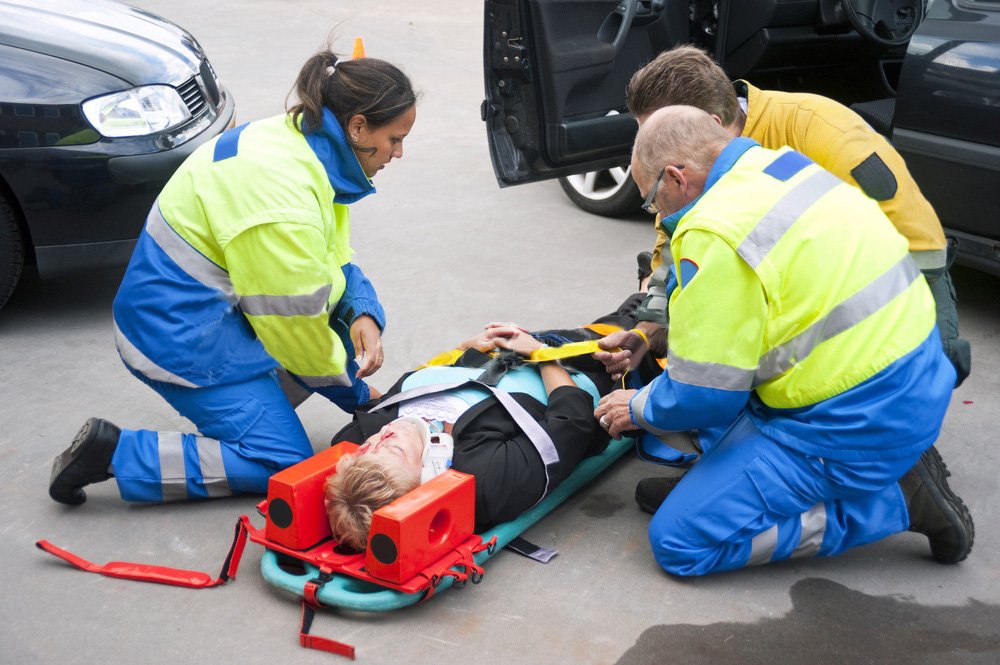
This article explains the equipment and its relationship with a spine board. It is written for trained EMS, rescue, healthcare, and procurement teams, not as patient-specific treatment instructions.
What Is a Head Immobilizer?
A head immobilizer, sometimes called a head block system or head restraint system, is designed to reduce unwanted head movement during patient handling, extrication, transfer, or transport.
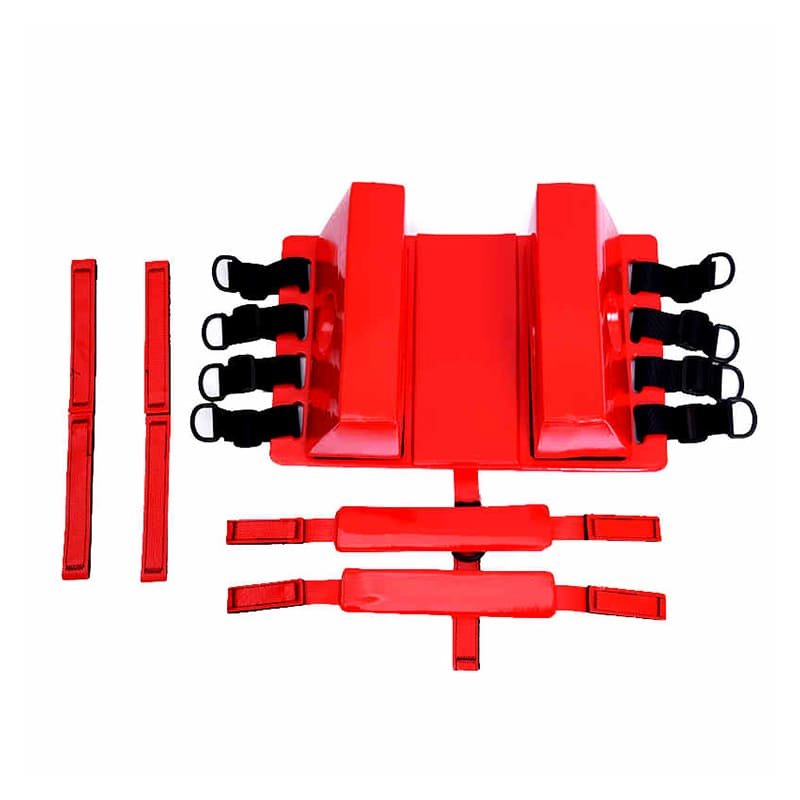
Most reusable models have four main elements:
| Component | What it does |
|---|---|
| Base plate | Attaches the system to a spine board or compatible transport surface |
| Two side blocks | Support both sides of the head and limit lateral movement and rotation |
| Forehead strap | Helps keep the upper part of the head positioned between the blocks |
| Chin strap | Adds a second point of control when permitted by the device instructions |
Many side blocks also have large ear openings. These are useful because the responder may still need access to the ears for observation and communication.
The exact construction varies. Some head immobilizers use coated foam, some use molded plastic, and others are disposable. That is why the product name alone does not tell a buyer whether it is reusable, waterproof, suitable for imaging, or compatible with a particular board.
How Does a Head Immobilizer Work with a Spine Board?
I usually explain it this way: the spine board manages the body, while the head immobilizer manages the head’s position relative to the board.
The base plate is secured near the head end of the spine board. Once a trained team has positioned the patient according to its protocol, the side blocks are placed on either side of the head. The straps then help maintain the position between the blocks.
The instructions for an adult head immobilizer1 describe this same basic sequence: secure the base to the board, position the side blocks, and use separate straps across the forehead and chin. The instructions also warn against overtightening and obstructing the airway.

The important point is that the head cannot be considered separately from the torso. If the body can slide on the board while the head is tightly held, the system is not working as intended. The board, body straps, head blocks, and head straps must therefore be considered together.
Spine board instructions also commonly require manual head support to continue until the immobilizer is securely fastened. One spine board operating manual2 describes keeping the head supported by a responder until the head immobilizer is fixed, then securing the chest, pelvis, and legs to the board.
This is also why “immobilizer” should not be read as a promise of zero movement. Modern EMS guidance often uses the term spinal motion restriction because equipment can reduce unwanted movement but cannot guarantee complete immobilization. The NAEMSP joint position statement on spinal motion restriction3 reflects this updated terminology.
Does a Head Immobilizer Replace a Cervical Collar?
No. They have related but different jobs.
| Equipment | Main role |
|---|---|
| Cervical collar | Helps limit movement of the cervical region according to clinical assessment and protocol |
| Head immobilizer | Helps secure the head relative to a board or compatible transport surface |
| Spine board | Supports the body and provides a rigid surface for movement, extrication, or transfer |
| Body straps | Help prevent the torso, pelvis, and legs from sliding on the board |
A cervical collar does not attach the patient’s head to the spine board. A head immobilizer does not replace the support and fit provided by an appropriate collar when one is indicated.
That does not mean every trauma patient needs all of these devices. Current protocols may use different combinations depending on the injury, patient condition, transport plan, and medical direction. Trained personnel must decide when spinal motion restriction is appropriate.
Why Are There Holes in the Side Blocks?
Buyers sometimes assume the holes are there only to reduce weight. Their more useful purpose is access.
When the blocks are positioned correctly, the openings can leave the ears visible. This may help responders communicate with the patient and observe visible bleeding or fluid drainage without removing the blocks.
The openings also make it easier to see whether the two blocks are aligned evenly. But an ear hole is useful only if it actually lines up with the patient’s ear. Fixed blocks, limited adjustment, or an unsuitable size may reduce that benefit.
Will Every Head Immobilizer Fit Every Spine Board?
No. “Universal” deserves a closer look.
Compatibility depends on the shape and width of the base, the position of the board’s hand holes, the available strap paths, the fastening system, and the space around the patient’s head. A system may attach securely to one spine board and shift on another.
Before ordering, compare the head immobilizer with the exact spine boards your team uses. Do not rely only on a catalog photo.
Useful questions include:
- How does the base attach to the board?
- Which holes or handles are required for the straps?
- Does the base remain flat when the board is lifted or tilted?
- Can the side blocks be adjusted for different head sizes?
- Are the forehead and chin straps included?
- Can replacement straps or blocks be ordered separately?
- Has the combination been tested with the exact board model?
For a product example, see our YJK-16 head immobilizer. Its specifications and compatible equipment should still be checked against the buyer’s actual board, protocol, and intended environment.
Are Spine Boards Still Used for Transport?
This question matters because the role of the board has changed in many EMS systems.
A long spine board may still be used for extrication, lifting, or short transfer when the protocol calls for it. Some systems avoid prolonged routine transport on a hard board because of discomfort, pressure, respiratory effects, and other concerns.
The head immobilizer therefore should not be marketed as proof that every patient belongs on a spine board for the entire journey. Its role depends on how the service uses the board within its spinal motion restriction protocol.3
For a broader explanation of the equipment used together, see our spinal immobilization guide.
What Should Buyers Check Before Ordering?
The product looks simple, so it is easy to compare only price and color. In practice, the fastening system and maintenance details often matter more.
Board compatibility
Ask for base dimensions, strap positions, attachment drawings, and a sample test with the exact spine board.
Complete component set
Confirm whether the package includes the base, two blocks, board attachment straps, forehead strap, chin strap, and storage bag. A missing strap can make the kit incomplete.
Adjustment range
Check the usable distance between the side blocks and whether the blocks can be repositioned without losing fastening strength.
Material and cleaning
Reusable coated foam or plastic surfaces should tolerate the cleaning and disinfection process specified by the manufacturer. Seams, hook-and-loop areas, and strap stitching also need inspection.
Fastening performance
Hook-and-loop material can collect dirt and lose grip. Buckles, D-rings, straps, and attachment points should be checked for wear and damage before the device returns to service.
Imaging claims
Some products are described as radiolucent or compatible with X-ray, CT, or MRI. Request documentation for the exact model and complete configuration. Do not assume every strap, fastener, or accessory has the same compatibility.
Storage and replacement parts
Make sure the blocks will not be crushed under heavier rescue equipment. Ask whether straps, blocks, and bases are available separately and how the manufacturer defines retirement criteria.
What Common Problems Should a Team Watch For?
- The base shifts on the board. The attachment method may not match the board’s hole pattern or surface.
- The blocks are too far apart. The head can still rotate or move laterally.
- The blocks press too tightly. Poor sizing or overtightening can create pressure and discomfort.
- The straps are placed incorrectly. A misplaced strap can interfere with the airway, monitoring, or equipment access.
- The torso is not secured. Holding the head while the body slides defeats the idea of a coordinated system.
- A strap is missing after cleaning. Store and inspect the unit as a complete kit.
- The team assumes every board is compatible. Test the actual product combination before purchasing in volume.
These are good reasons to include the head immobilizer in regular equipment drills. Training should cover attachment, reassessment, removal, cleaning, inspection, and repacking with the exact models the team carries.
Frequently Asked Questions
Can a head immobilizer be used without a spine board?
Some models are designed for compatible stretchers, scoop stretchers, or other transport surfaces. Others require a specific board attachment. Follow the instructions for the exact model rather than assuming it works independently.
Can a cervical collar replace head blocks?
Not automatically. A collar and a head immobilizer control movement in different ways. Equipment selection should follow the clinical assessment, local protocol, and product instructions.
Are head immobilizers reusable?
Some are reusable and some are disposable. Reusable models need written cleaning, drying, inspection, and replacement guidance.
Can a head immobilizer remain in place during imaging?
Only if the manufacturer documents compatibility for the exact model and imaging method. Check the complete system, including straps and fasteners.
Should the head be secured before the body?
The whole system must prevent the torso from sliding relative to the secured head. Trained teams should follow their protocol and the device instructions for the correct sequence while maintaining manual support until the system is secure.2
What should be checked before each use?
Check the base, side blocks, straps, seams, hook-and-loop surfaces, attachment points, labels, and board compatibility. Remove the device from service if components are missing, damaged, excessively worn, or no longer fasten securely.
Final Takeaway
A head immobilizer is a small device with a very specific job: it helps reduce movement of the head relative to a spine board or compatible transport surface.
The base connects the device to the board. The side blocks support the head. The forehead and chin straps add control. The spine board and body straps keep the rest of the patient from sliding beneath that fixed position.
For buyers, the important questions are compatibility, complete components, adjustment, fastening strength, cleaning, imaging documentation, and replacement parts. For users, the exact device instructions and local spinal motion restriction protocol remain the guide.
[Adult Head Immobilizer Instructions for Use](https://fernonorden.no/assets/product-images/5050602/IFU_EN_Adult_Head_Immobilizer_RevXX_XXXX.pdf) — Components, positioning, straps, warnings, and maintenance. ↩
[SmartEm, “Operating Instructions for Spineboard”](https://www.smartemergency.com/wp-content/uploads/BA-Spineboard-en-GB.pdf) — Use of a head immobilizer, manual support, and body straps with a spine board. ↩
[NAEMSP, “Spinal Motion Restriction in the Trauma Patient”](https://naemsp.org/position-statement/spinal-motion-restriction-in-the-trauma-patient/) — Joint position statement on current spinal motion restriction practice. ↩